
'La Traviata' in San Jose, a Grand Opera Reimagined
/By Elsa Tranter
4/24/2026
Photo credit: Dave Lepori | San Jose Opera
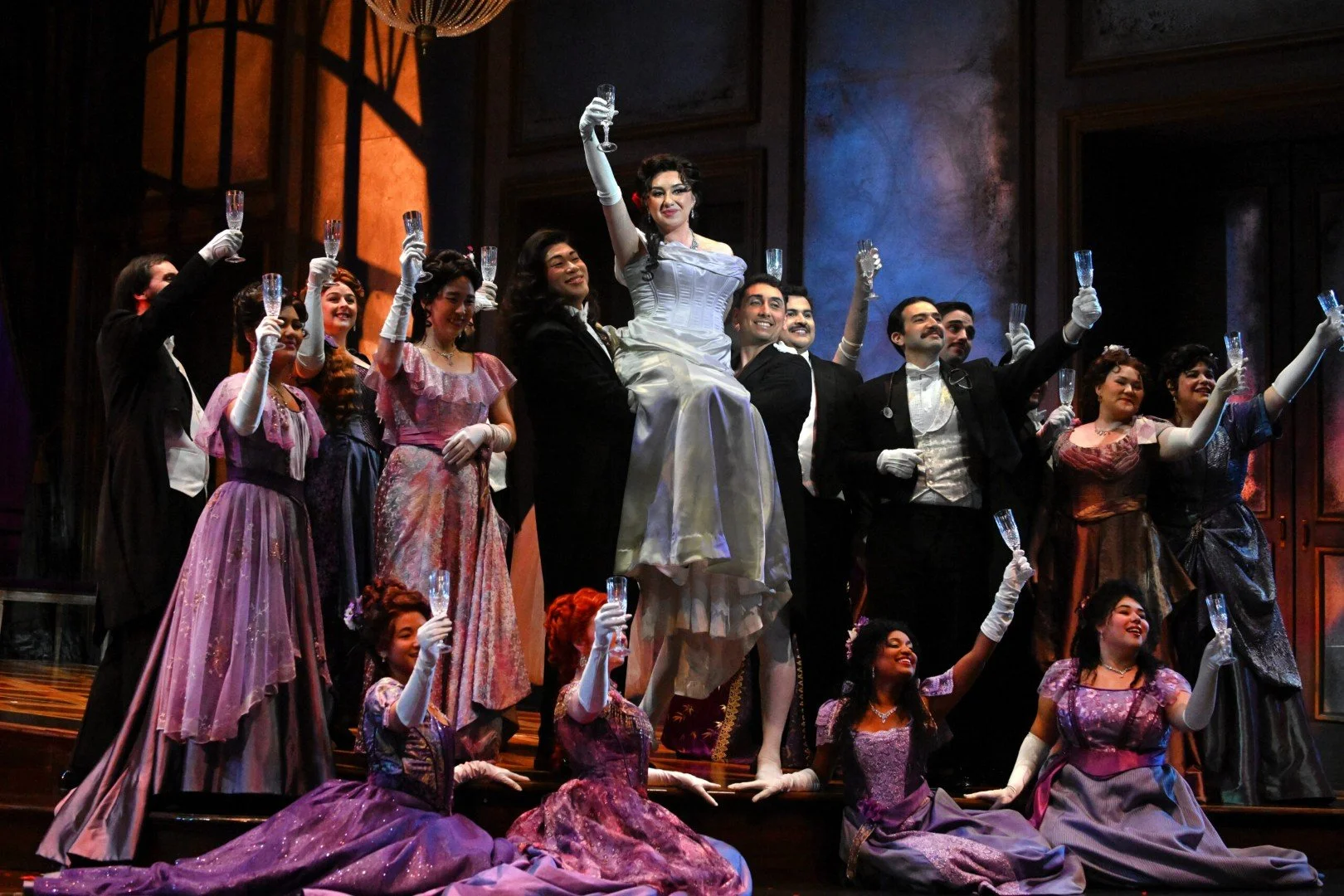
Violetta (Mikayla Sager) in san jose opera’s 2026 production of la traviata
For its final production of the season, Opera San Jose has mounted a beautiful re-telling of the Guiseppe Verdi’s oft-told story (La Traviata translates to “The Fallen Woman”). The libretto was written by Francesco Maria Piave. I saw the opening performance on Sunday April 19 and was swept away by the staging, the drama, the music and the singing. This is what makes a classic a classic – it holds up to many viewings over the centuries.
The drama, familiar to most of us, originated with the true story of Marie Duplessis, a mid-19th century courtesan, the “queen of the horizontales” , who lived and died (at age 23) in Paris. Among her many admirers were Franz Liszt, Alexandre Dumas fils, and, perhaps, Dumas père. Within a year of her death Dumas fils wrote La Dame aux Camelias, which was a big success. Five years later Dumas revised it for the theater where it was most likely seen by Verdi who wrote the opera for his companion the singer Giuseppina Strepponi. The opera had its premiere in 1853 at La Fenice in Venice. Although Verdi and Piave both wanted it to be performed in the current time period, the authorities at the opera house prevailed upon him to set it around 1700. It was only thirty years later that it was performed as Verdi wanted it to be. The story tells of Violetta who finds true love with Alfredo, the wealthy son of a nobleman and they go off to the country to live the simple life. Alas, their tranquility is upset by the arrival of papa Germont who begs Violetta to give him up for the sake of the family name—the young sister Germont is engaged to a man whose family would not let her marry because of Violetta’s past. She goes back to her life as a courtesan but as she lays dying of consumption, Alfredo and then papa return to beg her forgiveness and she dies happy.
OSJ’s production was updated, not to our time, but to modernize our understanding of Violetta’s situation. Her profession as a kept woman, trading her body for an elegant life-style, was made more explicit than in many productions. The most obvious was when men were throwing money at her (and others) feet. The staging was elegant and provided the right degree of interest without distracting from the music. One striking note was the very large picture window with the Eiffel Tower in the background (partially built in Act I and completed by Act II to set the time with great accuracy) For the interlude in the French countryside there was a ‘Monet’s Garden’ view from the window.
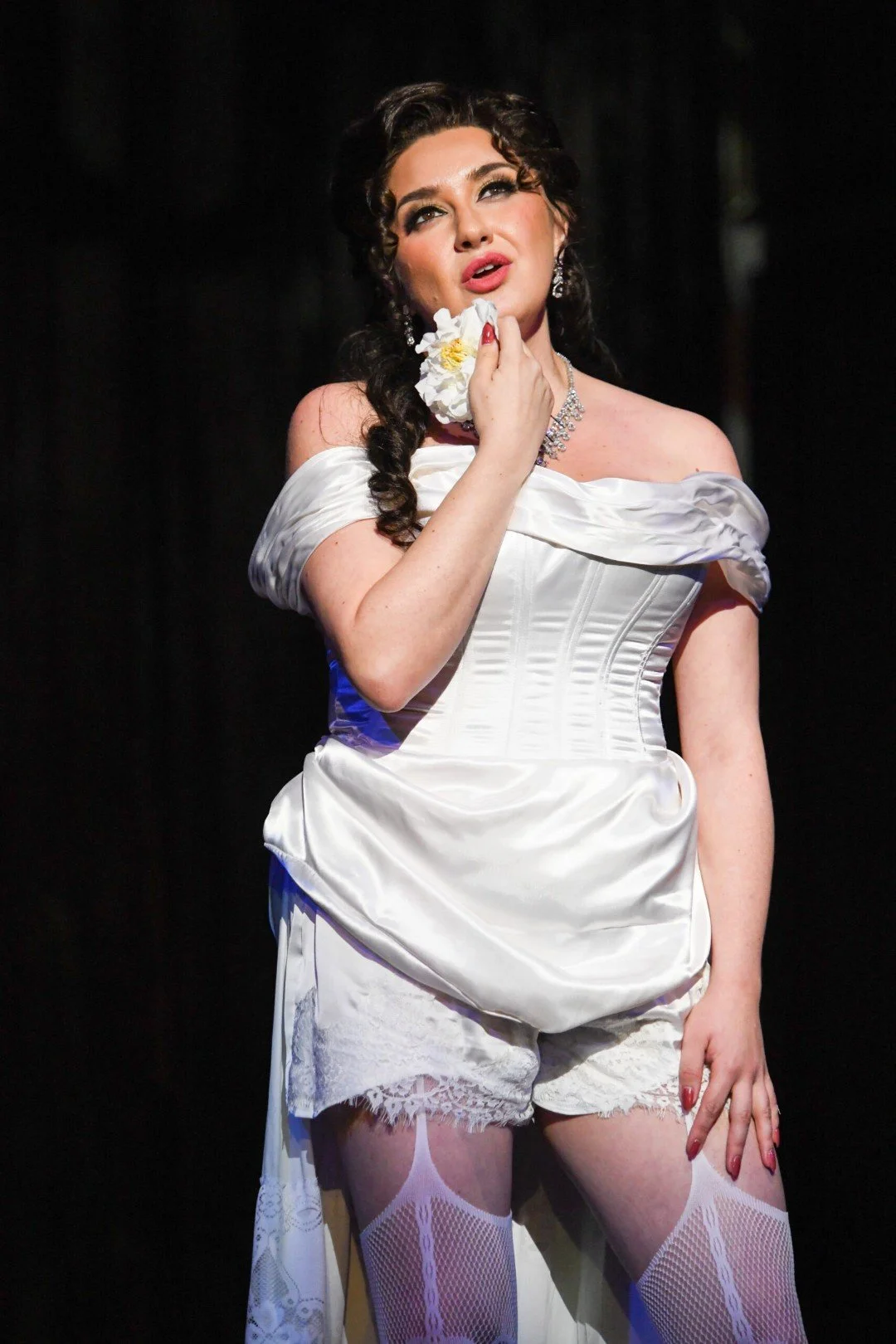
Another strong image was the large portrait of (presumably) Violetta on the wall, dressed all in white, as was the singer in the first act. In the final act the portrait was laying sideways on the floor as our Violetta lay dying in the bed, also in white. The other main characters were dressed appropriately without standing out in any way. The costumes of the chorus were, at the beginning, shades of purple, all glamorous; in the second act party scene they were all in shades of red and orange. All terrific! The overall look of the stage was very pleasing to the eye. Director Tara Branham, Scenic Designer Erik Flatmo, Costume designer Elizabeth Poindexter, Lighting Designer Mitchell Ost, and Hair, Wig and Makeup Designer Christina Martin all deserve praise for a very well integrated production.
The size of the theater (just over 1100 seats) and the layout and acoustics make for an excellent balance between grand and intimate, from orchestra to balcony. It is comparable to England’s Glyndebourne and Venice’s Teatro La Fenice (where Traviata had its premiere) in the select ranks of the world’s most intimate opera houses. And the theater itself, the California, is a work of art, an extraordinary aesthetic experience of Art-Deco elegance. It was completely restored to its 1920s movie-theater lavish grandness at the turn of the 21st century.
On to the singing. The title role of Violetta was very beautifully sung by Mikayla Sager, originally from Vancouver, BC and a former Adler Fellow with San Francisco Opera. She was last seen at OSJ as Nedda in Pagliachi back in February where she showed off her comic skill as well as the tragic side of the story. She has a big and expressive voice and acts as well as she sings. She was a compelling performer from start to finish, totally believable as a flirtatious, elegant and independent courtesan and later as a woman in love and enjoying her life in the country. There were several playful touches to her performance which added to the enjoyment. Finally she was persuasive as she suffered her final illness and death. Her voice managed to fill the house even as she struggled in her last moments (not vocal suffering but the suffering of dying).
Alfredo Germont, the wealthy Parisian who falls in love with her, was ably sung by South Korean tenor Woo Young Yoon, a former OSJ artist-in residence. My first impression of him was that he was a little mismatched for Violetta, but his voice grew and his personality seemed to become stronger over the course of the opera and he became quite believable. His arias and their duets were glorious and breathtaking.
Aflredo’s father, the senior Germont, older and more traditional, was sung with appropriate gravitas by another South Korean, baritone Kidon Choi. He was seen earlier this year as Alfio in Cavalleria Rusticana and as Tonio in Pagliacci. Not so much acting was called for in this part, but his is a strong and expressive voice. His last aria, where he asks forgiveness for his earlier strictness, was quite beautiful.
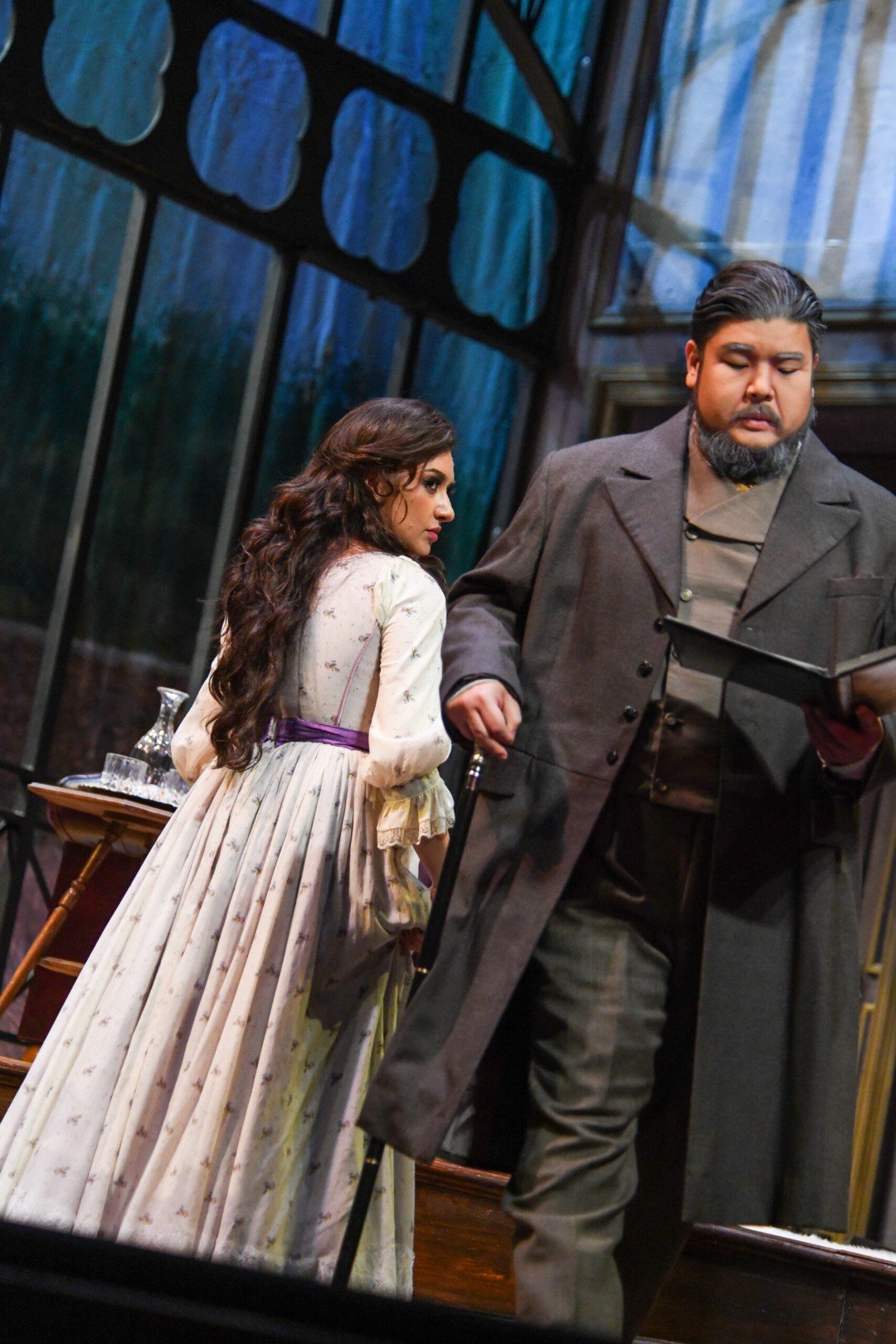
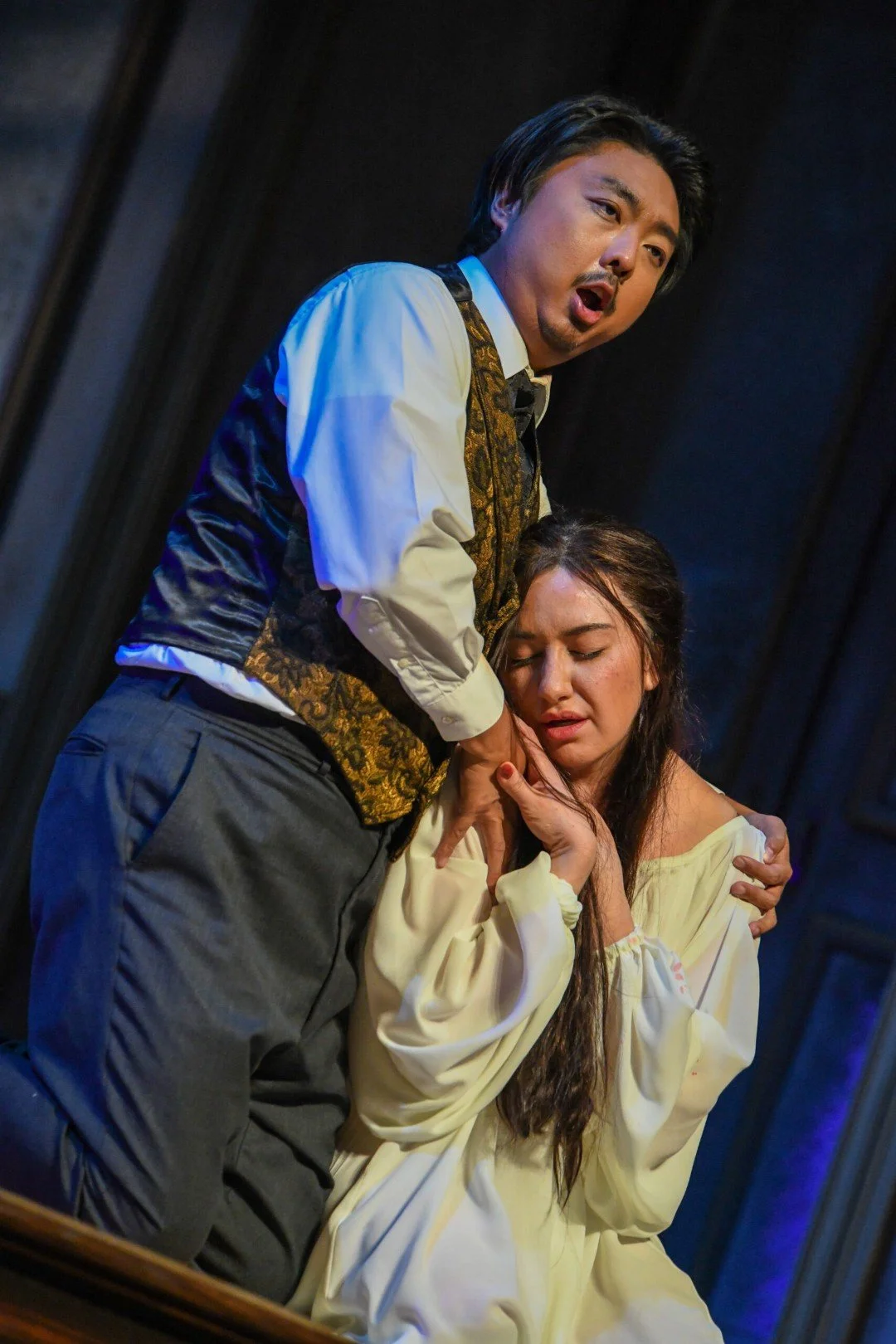
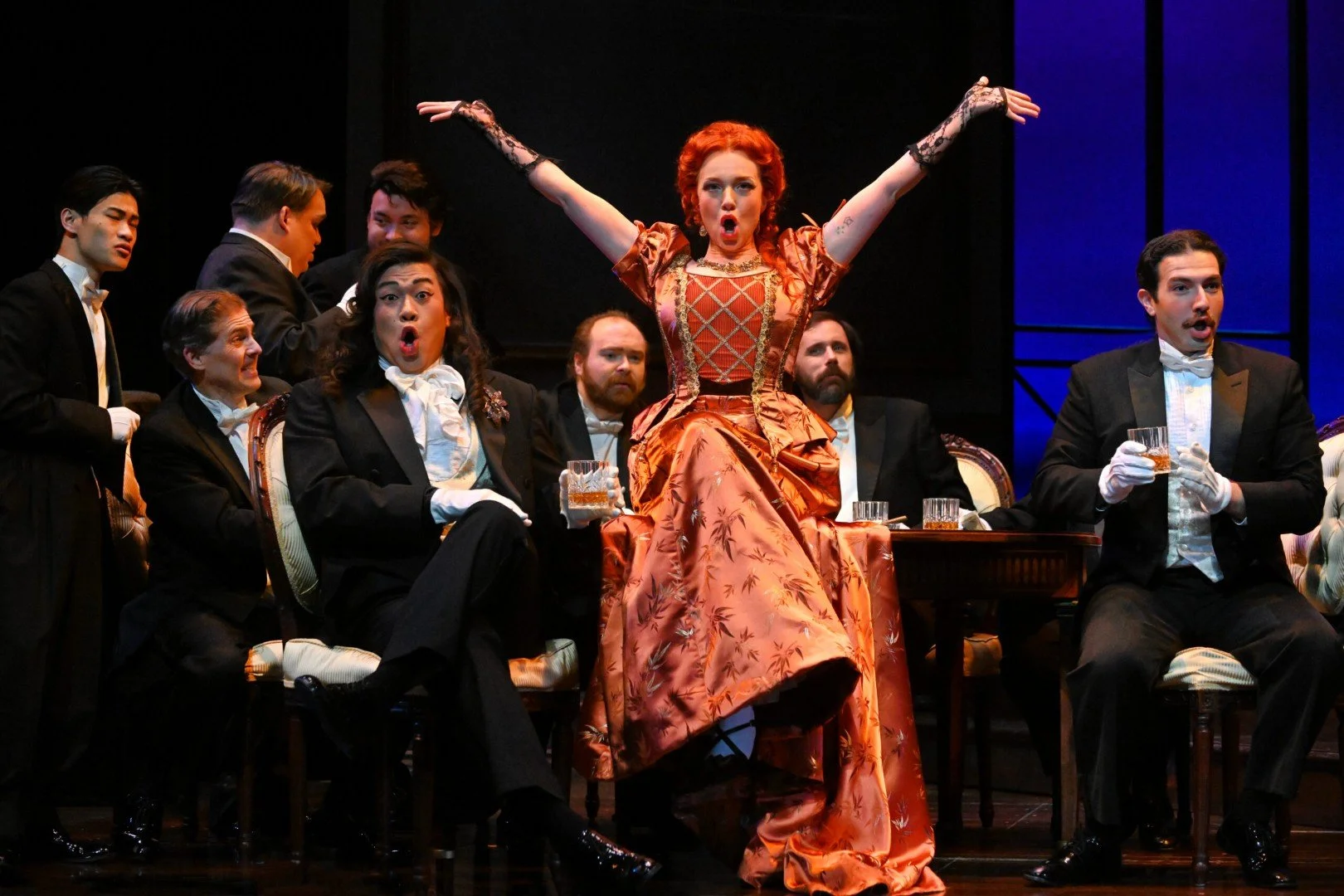
In supporting roles were Flora the party hostess and friend of Violetta played by OSJ artist-in residence mezzo-soprano Joanne Evans (a native of London); Annina the devoted maid, played by OSJ artist-in-residence soprano Nicole Koh (born in Daly City); the young nobleman Gastone, played by tenor Benjamin Ruiz; Baron Douphol, the wealthy and possessive suitor played by baritone Robert Balonck; and the kindly Dr. Grenville played by bass-baritone Joseph Calzada. Rounding out the cast were baritone Michael Jesse Kuo and tenor Nicolas Vasquez-Gerst. All were up to the high standard set by the principal performers in both singing and acting. The chorus members and dancers as well made the whole experience a true ensemble working together with nary a weak link.
Former Artist-in Residence Johannes Löhner made his OSJ mainstage conducting debut. He is a German-American citizen who has taught and conducted in both countries. He led an orchestra that sounded rich and full, though I didn’t get a count of the numbers. The tempos and balance with singers were all just what was called for.
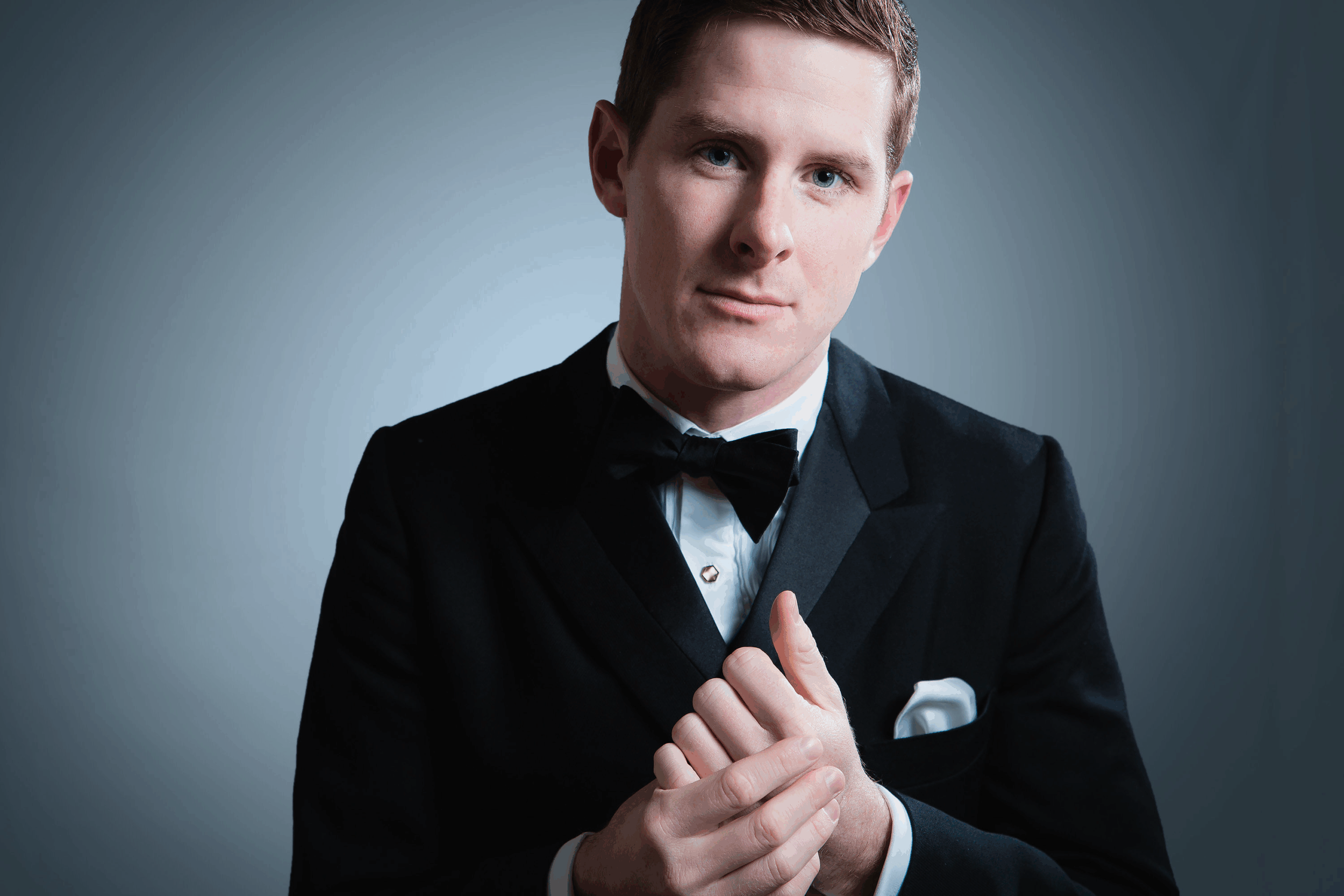
Conductor Johannes Löhner
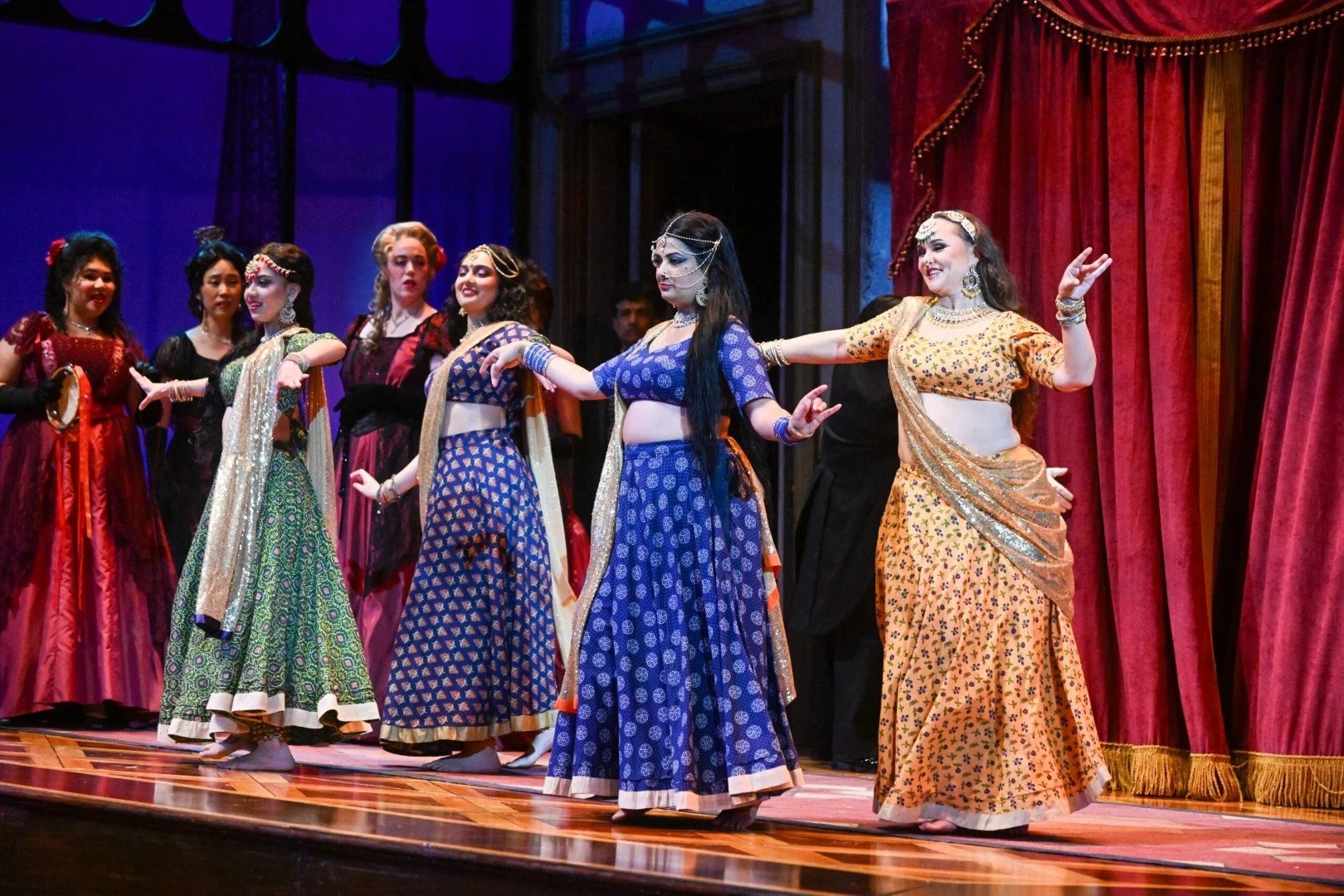
A special note about the dancers in the party scene. They were a troupe of Kathak-inspired South Asian dancers (rather than the usual Spanish ) but they fit in well with the music. Their choreographer was the well-known Antara Bhardwaj. The shift did not seem out of place (though it might have, as I wonder how much mid18th century Italians would have known about South Asian dancers); instead it emphasized the trans-national outlook of the director, Ms. Branham and the cultural diversity represented in the San Jose area. Another indication of this diversity is the use of Spanish as well as English surtitles.
Overall, this was a most entrancing and emotionally gratifying experience. It is well worth whatever effort it may take to get to the remaining performances: Fridays April 24 and May 1 at 7:30 and Sundays April 26 and May 3 at 2:00.
Elsa Tranter is a Bostonian who has lived in Berkeley for over 50 years and has been an opera goer for most of those years. She worked as a graduate student adviser at UC Berkeley and still attends Cal Performances regularly. Her favorite composer is Wagner and her favorite opera is Les Troyens.