
Met's 'Fidelio' Triumphs Despite Untidy Conducting
/By Raymond Beegle
3/12/2025
Photo credit: Karen Almond | Met Opera
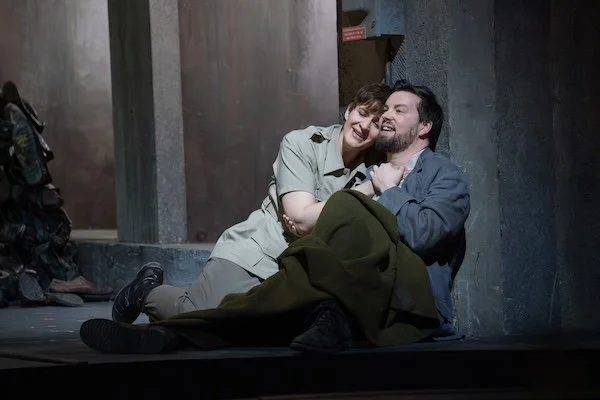
Lise Davidsen as Leonore and David Butt Philip as Florestan
Time is our greatest critic. Out of the thousands of operas written from the Renaissance to the present day, only a hundred or so have survived and make up the standard repertoire we hear in the major theaters. Of this number, most were commissioned and only a few were written purely out of inspiration. Beethoven’s Fidelio is the greatest among them, as the composer was deeply moved by the true story of a political prisoner saved by a faithful young wife who disguised herself as a boy, worked in that prison, and managed his escape. The Metropolitan Opera went to great trouble and expense to hire the world’s most celebrated artists and tried its best to deliver the superlative performance the piece deserves.
Despite a brilliant cast of singers there were many difficulties in this production. Conductor Susanna Mälkki presided over an orchestra that did not give her their best. From the outset both brass and strings had intonation problems and made ragged entrances, and the entire orchestra rarely played as a unified ensemble throughout. Singers were constrained by rigid tempos: moderate and slow movements were sometimes too slow, and often a fast sequence of notes was too fast for an artist to negotiate with sufficient articulation. Mälkki did not accommodate her colleagues, and sometimes they fought back, resulting in a push and pull between orchestra and soloist. The underlying fatal element however proved to be the lack of a decisive rhythmic thrust as well as a stylistic approach suitable perhaps to Mozart or Haydn, but certainly not to the dramatically aggressive Beethoven.

Lise Davidsen as Leonore, Tomasz Konieczny as pizzaro
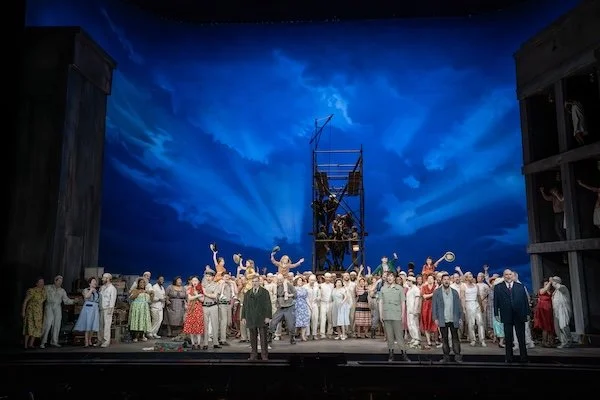
The hero of the evening was the chorus, due in part to its radiant tone, but due primarily to the superlative leadership of its director, Tilman Michael and his musical prepararion. In both the prisoner’s chorus, and the second act finale, the ensemble’s personality eclipsed that of the conductor, and the entire production burst into radiant life.
The cast was close to ideal. Lise Davidsen is the best Leonora we have, and although she does not possess the golden trumpet sound of Nilsson or Flagstad, she delivers a solid performance with especially dazzling top notes; Ying Fang was a sweet voiced and convincing Marzelline; sweet voiced and convincing as well was tenor Magnus Dietrich in the role of her suitor, Jaquino. David Butt Philip, the evening’s Florestan, was a perfect match for Davidsen’s Leonore. Philip’s dramatic power, like hers lies in brilliance of vocal quality, rather than quantity of sound. René Pape who was in this production’s first run 25 years ago sang Rocco with slightly diminished resources, but with beauty of tone and a convincing generosity of spirit. Bass-baritone Tomasz Konieczny’s dark voice and dramatic temperament could easily have made a cliché of the villainous Don Pizarro but Konieczny is a fine actor as well, and never wandered over the borders of overstatement.
The music of Fidelio has an organic connection with the time in which the drama takes place. 17th century Spain, its architecture, its objects, the lines and contours of its clothing, has an expressed kinship with Beethoven’s score. What we saw this evening, however, was the world of today: The watch towers of the prison were watch towers of present times; Rocco and Pizarro, in their three-piece suits could have just as well walked on stage from row L, seat 12 and 13 in the theater. ‘Fidelio’ might have made a more powerful impression if the visual world reflected Beethoven’s glorious music and its heroic message as well.
Raymond Beegle reviews classical music and opera for the New York Observer and Fanfare Magazine. For many years he was Contributing Editor of Opera Quarterly, the Classic Record Collector (UK), and also appeared on The Today Show (NBC) and Good Morning America (CBS). As an accompanist, he has collaborated with Zinka Milanov and Licia Albanese. Currently Mr. Beegle serves on the faculty of Manhattan School of Music in New York City.